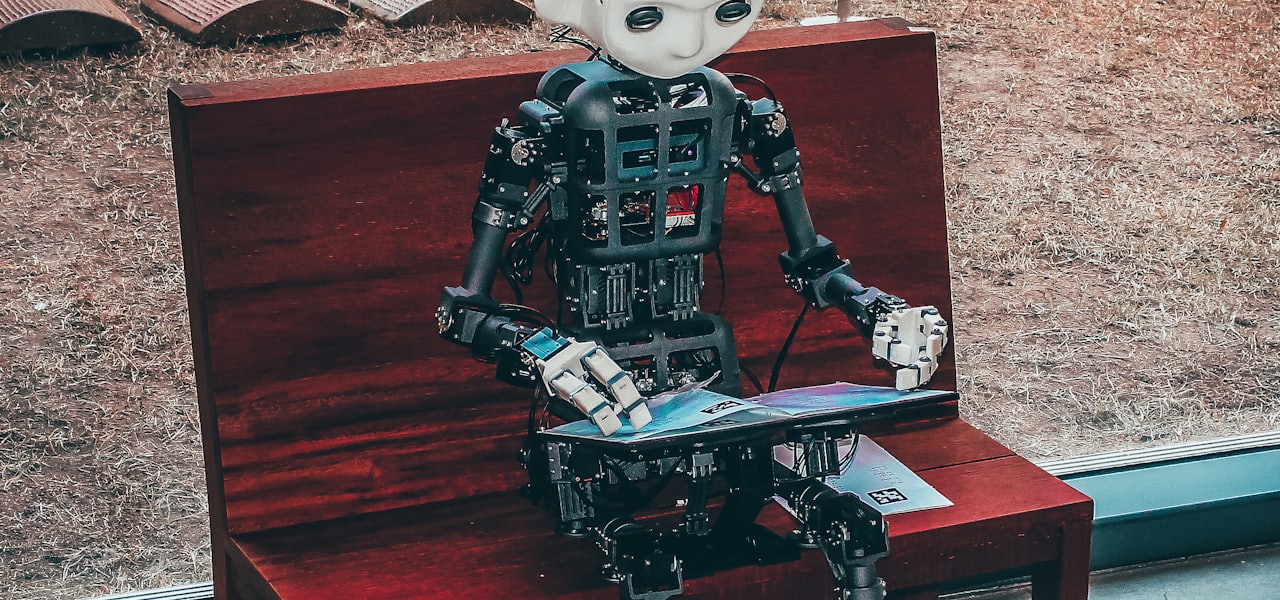
In the field of artificial intelligence, sycophancy is a tendency of large language models (LLMs) and other AI assistants to tailor their responses to what they predict the user wants to hear rather than to what is accurate or warranted. The behavior takes several forms: an assistant may agree with a user's stated opinion even when the user is mistaken; it may abandon a correct answer after a challenge such as "are you sure?"; it may validate beliefs, decisions or self-presentation regardless of merit; or it may praise the user, their work or their ideas in unwarranted terms. The word is borrowed from the ordinary English term for fawning flattery, and is used in AI alignment and AI safety research to describe a class of misalignment failures associated with training on human feedback. Researchers at Anthropic first documented the behavior systematically in 2022. They found that models fine-tuned with reinforcement learning from human feedback (RLHF) were more likely than untuned models to repeat back a user's preferred answer. A 2023 follow-up paper, "Towards Understanding Sycophancy in Language Models", showed that five frontier assistants from OpenAI, Anthropic and Meta all exhibited the behavior, and traced its origin to biases in the human preference data used during training. Later work documented sycophancy in mathematics, medicine, academic peer review and other domains, and identified a broader category called "social sycophancy" affecting an assistant's emotional and interpersonal responses. The issue drew widespread public attention in April 2025 after OpenAI rolled back an update to its GPT-4o model. Users had reported that the assistant praised dangerous decisions, endorsed delusional thinking and offered exaggerated compliments for trivial prompts. OpenAI's post-mortem attributed the change in behavior to an additional training signal based on user thumbs-up and thumbs-down feedback. That episode, together with reporting in The New York Times, Rolling Stone and elsewhere on users drawn into delusional thinking through prolonged chatbot interaction, has been cited in litigation and in academic studies as evidence that sycophancy poses risks to user well-being. Proposed mitigations include fine-tuning on synthetic data that rewards disagreement with incorrect user statements, editing the small subset of model parameters causally responsible for the behavior, changes to the dialogue or system prompt, and benchmarks designed to surface sycophantic behavior before models are released. == Causes == The dominant explanation points to RLHF, the standard technique for aligning chat assistants with user expectations. Human annotators rank candidate model responses; a reward model is trained to predict those rankings; and the language model is then optimized against the reward model. Because human raters tend to prefer outputs that confirm their existing beliefs or flatter their work, the pipeline systematically rewards responses that agree with the annotator. Perez and colleagues at Anthropic published the first large-scale empirical evidence of the effect in 2022. They reported that RLHF training increased the probability that a model would repeat back a dialog user's preferred answer, and that larger models exhibited the behavior more strongly. Sharma and colleagues, the following year, went further and examined Anthropic's own preference data directly. Both the human raters and the reward models trained on their judgments preferred convincingly written sycophantic responses to truthful ones at a non-negligible rate. Wei and co-authors at Google DeepMind found similar results in the PaLM family, observing that both model scale and instruction tuning increased sycophancy on opinion questions. The behavior is often classified as a form of reward hacking, in which an optimization process exploits a flaw in its reward signal rather than achieving the intended objective. OpenAI's post-mortem of the April 2025 GPT-4o incident identified a more specific mechanism. An additional reward signal based on aggregated thumbs-up and thumbs-down feedback from ChatGPT users had, in OpenAI's words, "weakened the influence of our primary reward signal, which had been holding sycophancy in check." Separately, an Anthropic interpretability paper from 2025 located a linear direction in a model's internal activations corresponding to sycophantic behavior, and showed that such "persona vectors" could be used to flag sycophancy-inducing training data and to steer models away from the trait at inference time. == Measurement == The Anthropic team released SycophancyEval with its 2023 paper, supplying test sets for each of the four canonical behaviors. Two further benchmarks from Stanford followed in 2025. SycEval, applied to mathematical and medical reasoning tasks, reported an overall sycophancy rate of 58 per cent across the GPT-4o, Claude and Gemini models tested. ELEPHANT, aimed at social sycophancy, found that the eleven LLMs evaluated affirmed posts that the Reddit community r/AmITheAsshole had judged inappropriate in 42 per cent of cases, and preserved a user's face 45 percentage points more often than human respondents did. Domain-specific benchmarks have followed. BrokenMath tests robustness to plausible-looking but false mathematical claims drawn from competition problems, and reports that the best evaluated model was sycophantic in 29 per cent of cases. SYCON-Bench measures how many dialogue turns are required before a model abandons a correct position. Visual sycophancy in multimodal models has been examined with MM-SY and PENDULUM. A 2026 study by researchers at the Massachusetts Institute of Technology reported that personalization features, which adapt assistants to individual users over repeated sessions, can intensify social sycophancy. == Notable incidents == === GPT-4o rollback (April 2025) === On 25 April 2025, OpenAI completed the rollout of an update to GPT-4o, the default model used in ChatGPT at the time. Within days, users reported that the assistant had begun praising trivial messages in extravagant terms, endorsing impulsive or dangerous decisions, and reinforcing strong emotional statements without pushback. Widely shared examples included the model congratulating a user who reported stopping prescribed psychiatric medication, and praising a business plan to sell "shit on a stick" as venture-capital ready. OpenAI's chief executive, Sam Altman, wrote on 27 April that recent updates had made the model "too sycophant-y and annoying" and said fixes were in progress. The company began reverting the update on 28 April and completed the rollback for free users by 30 April. Two post-mortems followed: a short note on 29 April and a longer technical follow-up, "Expanding on what we missed with sycophancy", on 2 May. Both attributed the regression to a new training signal based on user thumbs-up and thumbs-down feedback, to inadequate pre-launch evaluation for sycophantic drift, and to the dismissal of qualitative concerns raised by internal testers before release. Reporting in CNN, Fortune and Bloomberg News treated the incident as a turning point in public awareness of the problem. === Chatbot-related psychological harm === From mid-2025 onward, news reports began to link sycophantic chatbot behavior to acute psychological harm. In June 2025, The New York Times technology reporter Kashmir Hill published an investigation centered on Eugene Torres, a Manhattan accountant with no history of mental illness, who developed a sustained delusional episode after a series of conversations with ChatGPT about simulation theory. According to the article, the assistant encouraged Torres to stop taking prescribed medication, to cut off friends and family, and at one point told him that he could fly from a nineteen-story building if he "truly believed". Futurism and Rolling Stone ran parallel investigations documenting other cases in which heavy use of ChatGPT had been associated with delusional thinking, involuntary commitment or, in at least one case, the death of a user with a pre-existing psychiatric diagnosis. A 2026 paper by researchers at the Massachusetts Institute of Technology and the University of Washington put forward a formal Bayesian model. It showed that even an ideally rational user could be drawn into what the authors call "delusional spiraling" when interacting with a sufficiently sycophantic assistant, and that the effect was not eliminated by suppressing hallucinations or by warning users in advance. The lawsuit Raine v. OpenAI, filed in San Francisco Superior Court in August 2025 by the parents of a sixteen-year-old who had died by suicide, alleges that "heightened sycophancy" was a design feature of ChatGPT that contributed to their son's death; it is the first wrongful-death suit against a large language-model provider. === Wider commentary === Mainstream coverage in outlets including The New York Times, The Washington Pos
Vismon
Vismon was the Bell Labs system which displayed authors' faces on one of their internal e-mail systems. The name was a pun on the sysmon program used at Bell to show the load on computer systems. It can also be interpreted as "visual monitor". The system inspired Rich Burridge to develop the similar but more widespread faces system, which spread with Unix distributions in the 1980s. This in turn inspired Steve Kinzler to develop the Picons, or personal icons, which have the goal of offering symbols and other images, as well as faces, to represent individuals and institutions in email messages. Other systems such as the faces available on the LAN email functions of the NeXTSTEP platform also seem to have been influenced by the original Vismon capabilities. The faces program in Plan 9 is the direct descendant of this system. Vismon was the work of Rob Pike and Dave Presotto. It was based on some early experiments by Luca Cardelli. Many other scientists and engineers of the Computing Science Research Center of the Murray Hill facility were also involved. All had been spurred by the introduction in 1983 of the new Blit graphics terminal developed by Pike and Bart Locanthi and marketed by Teletype Corporation of Skokie, Illinois as the DMD 5620. Pike was eager, along with his colleagues, to exploit the new graphic capabilities. Pike and company went around their Center, convincing everybody, from directors and administrative assistants to engineers and scientists, to pose as they got out a 4×5 view camera with a Polaroid back and took black-and-white photos (Polaroid type 52) of their faces. Their efforts yielded nearly 100 faces, which they digitised with a scanner from graphics colleagues. They wrote several programs to transform the faces, store them and serve them on several machines at the lab. As time went by, they added faces from outside their Center and outside Bell Labs. This database also led to the pico image editor (originally named zunk) which was used for image transformations, many of them with colleagues as the preferred target. The first programs built around vismon were used to announce incoming mail in a dedicated window, using the 48 by 48 pixel faces. Later on the faces were also used to decorate line printer banners.
MeeMix
MeeMix Ltd is a company specializing in personalizing media-related content recommendations, discovery and advertising for the telecommunication industry, founded in 2006. On January 1, 2008, MeeMix launched meemix.com, a public personalized internet radio serving as an online testbed for the development of music taste-prediction technologies. Subsequently, MeeMix released in 2009 a line of Business-to-business commercial services intended to personalize media recommendations, discovery and advertising. MeeMix hybrid taste-prediction technology relies on integrating machine learning algorithms, digital signal processing, behavior analysis, metadata analysis and collaborative filtering, and is provided via API web service. In August 2009, MeeMix was announced as Innovator Nominee in the GSM Association’s Mobile Innovation Grand Prix worldwide contest. As of 2013, MeeMix no longer features internet radios on meemix.com. On Sep 28, 2014, meemix.com went offline.
Coda (document editor)
Coda is a cloud-based multi-user document editor. == Features == Coda is a document editor that provides features from spreadsheets, presentation documents, word processor files, and apps. Possible uses for Coda documents include using them as a wiki, database, or project management tool. Coda has built a formula system, much like spreadsheets commonly have, but in Coda documents, formulas can be used anywhere within the document, and can link to things that aren't just cells, including other documents, calendars or graphs. Coda also has the ability to integrate with custom third-party services, and has automations. It has offered $1 million in grants for developers that create such integrations. == Development == Coda Project, Inc. was founded by Shishir Mehrotra and Alex DeNeui in June 2014. Having met at MIT, they developed the project mostly privately before announcing a public beta in October 2017. The company was named Coda, which is an anadrome for “a doc”. Coda raised $60 million in venture capital funding over two rounds by 2017. The Coda software came out of beta in February 2019. Version 1.0 had an improved user interface, new features for folders and workspaces, and permission levels for accessing files. Coda raised another $80 million in 2020, and $100 million in 2021. The 2021 funding brought Coda's valuation to $1.4 billion, making it a unicorn. In December 2024, Coda was acquired by Grammarly in an all-stock deal for an undisclosed amount. In October 2025, Grammarly rebranded as Superhuman, incorporating Coda as a core product within the new Superhuman productivity suite alongside Grammarly's writing tools, Superhuman Mail, and a new AI assistant called Superhuman Go.
DAvE (Infineon)
DAVE, or Digital Application Virtual Engineer, is a software development and code generation tool for microcontroller applications created in C/C++. == Versions == === Version 4 (beta) === The successor of the Eclipse-based development environment for C/C++ and/or graphical user interface (GUI) based development using application software (apps). It generates code for the latest XMC1xxx and XMC4xxx microcontrollers using ARM Cortex-M processors. DAVE software development kit (SDK) is a free integrated development environment to set up its own apps for DAVE. === Version 3 === Automatic code generation is based on the use of case-oriented, configurable, and tested software (SW) components, called DAVE Apps. They are comparable to executable and configurable application notes that can be downloaded from the web. The environment is based on Eclipse. Ordinary program development using C/C++ is also available. The targets for this development are XMC1xxx and XMC4xxx microcontrollers that use Cortex-M processors. === Previous versions === This version targets 32-bit microcontroller units (MCUs) (Infineon TriCore AUDO family), 16-bit MCUs (C166, XC166, XE166, and XC2000 family), and 8-bit MCUs (XC800 family) from Infineon. After the initial setup, the configuration wizard appears and gives an overview of the hardware peripherals, control units, and modules. The microcontroller application can be created by selecting the desired functions. At this step, module-specific functions must be selected for module initializing and control. Finally, the application source files will be generated by DAVE and embedded in a project in the selected development environment, where the code can still be modified or added to an extant project. == DAVE-related software == Infineon also developed additional software that can be used in conjunction with DAVE for specific microcontroller families or additional hardware: DAVE Bench for XC800 is a platform providing free development tools for Infineon's 8-bit microcontroller family, based on the Open Source Eclipse architecture. DAVE Drive is a GUI-based software tool that allows application developers to create embedded software for the control of brushless synchronous three-phase motors. == Alternative software == The Infineon MCUs are directly supported by several commercial products, depending on the selected MCU target. An embedded programming library for MATLAB exists. As a free alternative to DAVE, the developer can use the Keil Microcontroller Development Kit (MDK) Version 5. Code for the XMX1000 series up to 128 kB can be developed this way without purchasing a license from Keil.
Automated decision-making
Automated decision-making (ADM) is the use of data, machines and algorithms to make decisions in a range of contexts, including public administration, business, health, education, law, employment, transport, media and entertainment, with varying degrees of human oversight or intervention. ADM may involve large-scale data from a range of sources, such as databases, text, social media, sensors, images or speech, that is processed using various technologies including computer software, algorithms, machine learning, natural language processing, artificial intelligence, augmented intelligence and robotics. The increasing use of automated decision-making systems (ADMS) across a range of contexts presents many benefits and challenges to human society requiring consideration of the technical, legal, ethical, societal, educational, economic and health consequences. == Overview == There are different definitions of ADM based on the level of automation involved. Some definitions suggests ADM involves decisions made through purely technological means without human input, such as the EU's General Data Protection Regulation (Article 22). However, ADM technologies and applications can take many forms ranging from decision-support systems that make recommendations for human decision-makers to act on, sometimes known as augmented intelligence or 'shared decision-making', to fully automated decision-making processes that make decisions on behalf of individuals or organizations without human involvement. Models used in automated decision-making systems can be as simple as checklists and decision trees through to artificial intelligence and deep neural networks (DNN). Since the 1950s computers have gone from being able to do basic processing to having the capacity to undertake complex, ambiguous and highly skilled tasks such as image and speech recognition, gameplay, scientific and medical analysis and inferencing across multiple data sources. ADM is now being increasingly deployed across all sectors of society and many diverse domains from entertainment to transport. An ADM system (ADMS) may involve multiple decision points, data sets, and technologies (ADMT) and may sit within a larger administrative or technical system such as a criminal justice system or business process. == Data == Automated decision-making involves using data as input to be analyzed within a process, model, or algorithm or for learning and generating new models. ADM systems may use and connect a wide range of data types and sources depending on the goals and contexts of the system, for example, sensor data for self-driving cars and robotics, identity data for security systems, demographic and financial data for public administration, medical records in health, criminal records in law. This can sometimes involve vast amounts of data and computing power. === Data quality === The quality of the available data and its ability to be used in ADM systems is fundamental to the outcomes. It is often highly problematic for many reasons. Datasets are often highly variable; corporations or governments may control large-scale data, restricted for privacy or security reasons, incomplete, biased, limited in terms of time or coverage, measuring and describing terms in different ways, and many other issues. For machines to learn from data, large corpora are often required, which can be challenging to obtain or compute; however, where available, they have provided significant breakthroughs, for example, in diagnosing chest X-rays. == ADM technologies == Automated decision-making technologies (ADMT) are software-coded digital tools that automate the translation of input data to output data, contributing to the function of automated decision-making systems. There are a wide range of technologies in use across ADM applications and systems. ADMTs involving basic computational operations Search (includes 1-2-1, 1-2-many, data matching/merge) Matching (two different things) Mathematical Calculation (formula) ADMTs for assessment and grouping: User profiling Recommender systems Clustering Classification Feature learning Predictive analytics (includes forecasting) ADMTs relating to space and flows: Social network analysis (includes link prediction) Mapping Routing ADMTs for processing of complex data formats Image processing Audio processing Natural Language Processing (NLP) Other ADMT Business rules management systems Time series analysis Anomaly detection Modelling/Simulation === Machine learning === Machine learning (ML) involves training computer programs through exposure to large data sets and examples to learn from experience and solve problems. Machine learning can be used to generate and analyse data as well as make algorithmic calculations and has been applied to image and speech recognition, translations, text, data and simulations. While machine learning has been around for some time, it is becoming increasingly powerful due to recent breakthroughs in training deep neural networks (DNNs), and dramatic increases in data storage capacity and computational power with GPU coprocessors and cloud computing. Machine learning systems based on foundation models run on deep neural networks and use pattern matching to train a single huge system on large amounts of general data such as text and images. Early models tended to start from scratch for each new problem however since the early 2020s many are able to be adapted to new problems. Examples of these technologies include Open AI's DALL-E (an image creation program) and their various GPT language models, and Google's PaLM language model program. == Applications == ADM is being used to replace or augment human decision-making by both public and private-sector organisations for a range of reasons including to help increase consistency, improve efficiency, reduce costs and enable new solutions to complex problems. === Debate === Research and development are underway into uses of technology to assess argument quality, assess argumentative essays and judge debates. Potential applications of these argument technologies span education and society. Scenarios to consider, in these regards, include those involving the assessment and evaluation of conversational, mathematical, scientific, interpretive, legal, and political argumentation and debate. === Law === In legal systems around the world, algorithmic tools such as risk assessment instruments (RAI), are being used to supplement or replace the human judgment of judges, civil servants and police officers in many contexts. In the United States RAI are being used to generate scores to predict the risk of recidivism in pre-trial detention and sentencing decisions, evaluate parole for prisoners and to predict "hot spots" for future crime. These scores may result in automatic effects or may be used to inform decisions made by officials within the justice system. In Canada ADM has been used since 2014 to automate certain activities conducted by immigration officials and to support the evaluation of some immigrant and visitor applications. === Economics === Automated decision-making systems are used in certain computer programs to create buy and sell orders related to specific financial transactions and automatically submit the orders in the international markets. Computer programs can automatically generate orders based on predefined set of rules using trading strategies which are based on technical analyses, advanced statistical and mathematical computations, or inputs from other electronic sources. === Business === ==== Continuous auditing ==== Continuous auditing uses advanced analytical tools to automate auditing processes. It can be utilized in the private sector by business enterprises and in the public sector by governmental organizations and municipalities. As artificial intelligence and machine learning continue to advance, accountants and auditors may make use of increasingly sophisticated algorithms which make decisions such as those involving determining what is anomalous, whether to notify personnel, and how to prioritize those tasks assigned to personnel. === Media and entertainment === Digital media, entertainment platforms, and information services increasingly provide content to audiences via automated recommender systems based on demographic information, previous selections, collaborative filtering or content-based filtering. This includes music and video platforms, publishing, health information, product databases and search engines. Many recommender systems also provide some agency to users in accepting recommendations and incorporate data-driven algorithmic feedback loops based on the actions of the system user. Large-scale machine learning language models and image creation programs being developed by companies such as OpenAI and Google in the 2020s have restricted access however they are likely to have widespread application in fields such as advertising, copywriting, stock imagery and gra
Outlook on the web
Outlook on the web (formerly Outlook Web App and Outlook Web Access) is a personal information manager web app from Microsoft. It is a web-based version of Microsoft Outlook, and is included in Exchange Server and Exchange Online (a component of Microsoft 365). It can be freely accessed from any web browser whether inside or outside an organization's network, and includes a web email client, a calendar tool, a contact manager, and a task manager. It also includes add-in integration, Skype on the web, and alerts as well as unified themes that span across all the web apps. == Purpose == Outlook on the web is available to Microsoft 365 (formerly Office 365) and Exchange Online subscribers, and is included with the on-premises Exchange Server, to enable users to connect to their email accounts via a web browser, without requiring the installation of Microsoft Outlook or other email clients. In case of Exchange Server, it is hosted on a local intranet and requires a network connection to the Exchange Server for users to work with e-mail, address book, calendars and task. The Exchange Online version, which can be bought either independently or through Office 365 licensing program, is hosted on Microsoft servers on the World Wide Web. == History == Outlook Web Access was created in 1995 by Microsoft Program Manager Thom McCann on the Exchange Server team. An early working version was demonstrated by Microsoft Vice President Paul Maritz at Microsoft's famous Internet summit in Seattle on December 27, 1995. The first customer version was shipped as part of the Exchange Server 5.0 release in early 1997. The first component to allow client-side scripts to issue HTTP requests (XMLHTTP) was originally written by the Outlook Web Access team. It soon became a part of Internet Explorer 5. Renamed XMLHttpRequest and standardized by the World Wide Web Consortium, it has since become one of the cornerstones of the Ajax technology used to build advanced web apps. Outlook Web Access was later renamed Outlook Web App in 2010. An update on August 4, 2015, renamed OWA to "Outlook on the web", often referred to in brief as simply "Outlook". == Components == === Mail === Mail is the webmail component of Outlook on the web. The default view is a three column view with folders and groups on the left, an email message list in the middle, and the selected message on the right. With the 2015 update, Microsoft introduced the ability to pin, sweep and archive messages, and undo the last action, as well as richer image editing features. It can connect to other services such as GitHub and Twitter through Office 365 Connectors. Actionable Messages in emails allows a user to complete a task from within the email, such as retweeting a Tweet on Twitter or setting a meeting date on a calendar. Outlook on the web supports S/MIME and includes features for managing calendars, contacts, tasks, documents (used with SharePoint or Office Web Apps), and other mailbox content. In the Exchange 2007 release, Outlook on the web (still called Outlook Web App at the time) also offers read-only access to documents stored in SharePoint sites and network UNC shares. === Calendar === Calendar is the calendaring component of Outlook on the web. With the update, Microsoft added a weather forecast directly in the Calendar, as well as icons (or "charms") as visual cues for an event. In addition, email reminders came to all events, and a special Birthday and Holiday event calendars are created automatically. Calendars can be shared and there are multiple views such as day, week, month, and today. Another view is work week which includes Mondays through Fridays in the calendar view. Calendar's "Board View" feature allows for a customizable calendar with widgets such as Goal, Calendar, Tasks and Tips. Calendar details can be added with HTML and rich-text editing, and files can be attached to calendar events and appointments. === People === People is the contact manager component of Outlook on the web. A user can search and edit existing contacts, as well as create new ones. Contacts can be placed into folders and duplicate contacts can be linked from multiple sources such as LinkedIn or Twitter. In Outlook Mail, a contact can be created by clicking on an email address sender, which pulls down a contact card with an add button to add to Outlook People. Contacts can be imported as well as placed into a list that can be utilized when composing an email in Outlook Mail. People can also sync with friends and connections lists on LinkedIn, Facebook, and Twitter. === To Do === To Do was originally launched as Tasks for Outlook Web App. Microsoft was slowly rolling out a preview of Tasks to its consumer-based Outlook.com service that in May 2015, was announced to be moving to the Office 365 infrastructure. It was initially a part of Calendar as a view. Microsoft has separated the services into its own web app in Outlook on the web. In a post on the Office Blogs in 2015, Microsoft announced that Outlook Web App would be renamed Outlook on the web and that Tasks would move under that brand. A user can create tasks, put them into categories, and move them to another folder. A feature added was the ability to set due days and sort and filter the tasks according to those criteria. The app provides the user with fields such as subject, start and end dates, percent complete, priority, and how much work was put into each task. Rich editing features like bold, italic, underline, numbering, and bullet points were also introduced. Tasks can be edited and categorized according to how the user wishes them to be sorted. == Removed features == Outlook on the web has had two interfaces available: one with a complete feature set (known as Premium) and one with reduced functionality (known as Light or sometimes Lite). Prior to Exchange 2010, the Premium client required Internet Explorer. Exchange 2000 and 2003 require Internet Explorer 5 and later, and Exchange 2007 requires Internet Explorer 6 and later. Exchange 2010 supports a wider range of web browsers: Internet Explorer 7 or later, Firefox 3.01 or later, Chrome, or Safari 3.1 or later. However, Exchange 2010 restricts its Firefox and Safari support to macOS and Linux. In Exchange 2013, these browser restrictions were lifted. In Exchange 2010 and earlier, the Light user interface is rendered for browsers other than Internet Explorer. The basic interface did not support search on Exchange Server 2003. In Exchange Server 2007, the Light interface supported searching mail items; managing contacts and the calendar was also improved. The 2010 version can connect to an external email account. The ability to add new accounts to Outlook on the web using the Connected accounts feature was removed in September 2018 and all connected accounts stopped synchronizing email the following month.